The Way Too Big Cabin
Fate has conspired to require me to make the trip between San Antonio and the Dallas/Fort Worth area four times in three months. The most direct route is Interstate 35, but driving that stretch of highway is unpleasant at best and unbearable at worst. And so for Thanksgiving (trip #3), my family and I decided to take a slight detour through Houston. By adding a number of stops, we transformed a 4+ hour slog into a a pleasant 3-day mini-vacation that completely avoided the I-35 corridor.
For the second night of our trans-Texas adventure, we stayed in a cabin at Fort Boggy State Park. Consisting of only 1,800 acres, it’s one of the smaller parks in the State Park system, and having opened to the public in 2001, it’s also one of the youngest. It also happens to contain some of the system’s most recently constructed cabins.
Most of the cabins available to rent at Texas State Parks were built in the 1930s and 1940s by the Civilian Conservation Corps (CCC). Typically small and rustic, these cabins were nevertheless imbued with a high level of care and craft due in no small part to the fact the federal government was supplying the “free” labor required for their construction. Additional cabin were built after the Second World War, but they tend to be more utilitarian and serve as an index of the low level of state park funding relative to the increasingly high cost of construction.
The cabins at Fort Boggy are unique in that they are relatively new (the first three of the now five cabins were completed in 2016). Although the cabins have electricity as well as a heating and air conditioning system, they do not have running water. A hose bib is provided near the entry of each cabin and a shared restroom/shower facility is located a short walk away.
Even when staying in a cabin, part of the appeal of visiting a state park is the act of “roughing it” on some level. And so for a single night’s stay, this arrangement was totally fine. Any inconvenience caused by my nocturnal hike to the men’s room was offset by the fact that the walk afforded me an impressive view of the Milky Way.
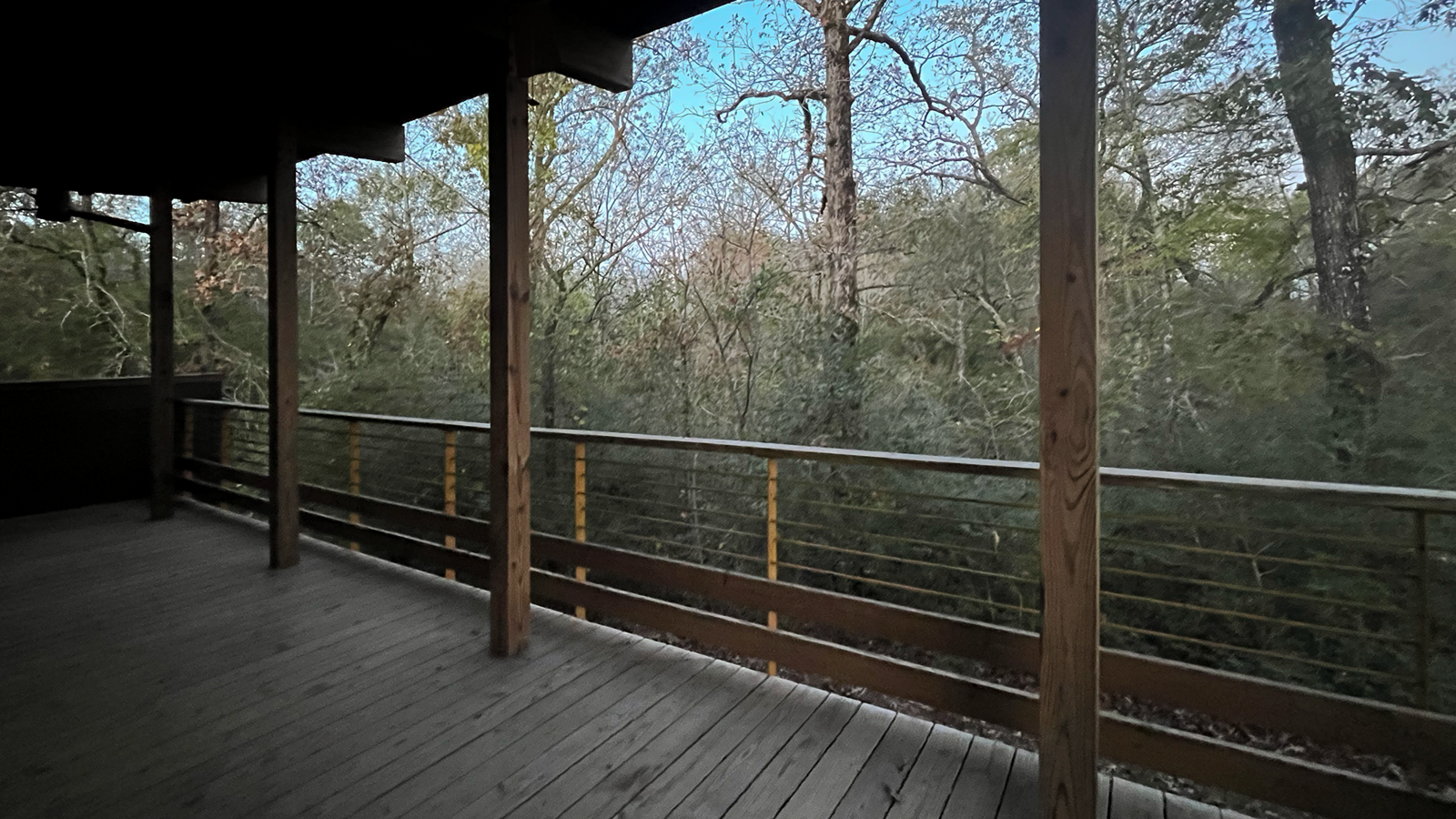
That said, from a design standpoint it seemed incredibly odd to not include a bathroom in cabin that did include an entry porch, a covered porch, and a screened porch that effectively double the 500 square feet of conditioned interior space. My biggest complaint wasn’t the lack of indoor plumbing, it was that the cabin itself was too big.
I’ve been thinking about cabins recently and my particular take is by no means the only one. That said, a small cabin does have the unique capacity to focus one’s attention outward to the large expanse of the natural landscape. Creating a contrast with the everyday is important, of course, as is finding the balance between too little and too much.
Finding that balance—both in architecture and in life—is worth the effort, as is avoiding I-35 at all costs.