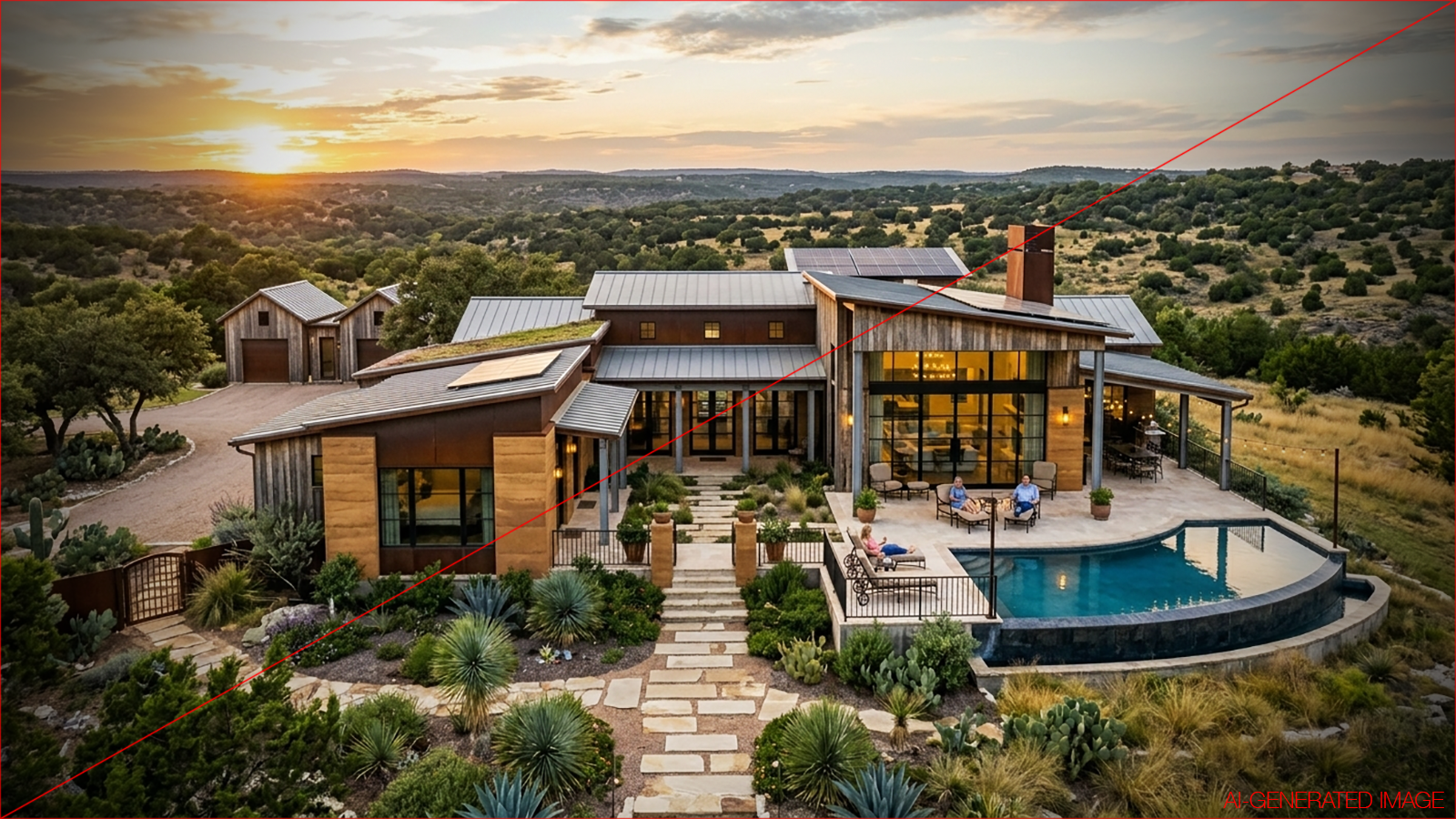
this cacophony of a house was generated by AI
I’m old enough to remember how personal computers were going to change everything back in the 1980s. I can recall hearing similar things about the world wide web in the 1990s, smartphones in the 2000s, and cloud computing in the 2010s.
Of course, these new technologies did change the world.
In both my private and professional life, I use my desktop computer and my mobile phone to access remote servers via the internet every day. This allows me to do things I couldn’t have imagined a decade (much less two or three decades) earlier. Of course, in that same span of time there have been emerging technologies that didn’t impact the world as much as was promised. Virtual reality and 3D printing, for example, have remain limited in their application while other technologies—social media being a notable example—have certainly changed the world even if they arguably haven’t changed it for the better.
As imprecise as the term may be, “artificial intelligence” certainly seems to be the technology that will define the 2020s. In the three years since Chat GPT became publicly available, it and other large language models came seemingly out of nowhere to suddenly be everywhere. This isn’t necessarily because AI is a mature technology that’s ready to be be deeply integrated into our lives, but because the corporations who have funded its development have a vested (if not existential) interest in making a return on that investment and so are forcing “AI features” upon us regardless of if we want them or not.
To be clear, I do not stay awake at night worrying that AI will produce too many paperclips and/or enslave humanity. As a younger member of Generation X who grew up in the 80s and 90s watching Terminator (and later Matrix) movies, perhaps I should be more concerned about those scenarios, but they seem to me far less likely while what seems far more likely is that over-investment has created a speculative bubble that will wreck the economy when it inevitably bursts.
In other words, I worry more about irrational exuberance than misaligned superintelligence.
At the risk of sounding like a middle-aged Luddite who is unwilling to embrace a future he doesn’t understand, AI as it exists today certainly seems at the very least to be an overhyped technology. Playing around with a chatbot is fun and there are a handful of tools that have certainly been improved by AI technology, but I don’t know that it justifies the resources going into expanding its capabilities and compelling its usage in situations where it is neither needed or wanted. Although the "AI Overview” provided by Google at the top of its search results can sometimes be helpful, it merely cuts through the pages of “sponsored results” to provide the basic information a Google search once provided without AI technology (see previous essay on “Enshittification”). Then again, the AI Overview can also hallucinate inaccurate information and I don’t need AI summaries of single-sentence emails. Similarly, Photoshop’s “Generative Expand” tool can produce impressive results, but similar outcomes can be accomplished using preexisting tools. I don’t need Photoshop to create entirely AI-generated images, and I certainly don’t like that Adobe is using these and other AI features to rationalize increasing their subscription rates.
As an architect, AI has yet to impact my industry in any significant way. The technology’s infamous lack of precision may not be an issue if you want to create an image of the Pope wearing a stylish coat, but while it might be difficult to notice if a pictured hand is missing a finger or two, it would definitely be noticed if a building is built missing a structural column or two.
All that said, there has been some movement around the edges. AI rendering tools have begun to appear and I’ve noticed in the past few months that clients are increasingly sharing AI-generated precedents with me.
This latter use of AI is an interesting case. On the one hand, one of the first things I like to do when meeting with a new client is to share photos of existing buildings to get a better understanding of the “feel” they are wanting their design to achieve. It allows us to engage in a discussion that creates a better understanding of what the client actually means when they say they, for example, want a “modern hacienda” for their home in the hill country. Based on the images that resonate with them, we can begin to craft an appropriate architectural vocabulary.
Now, of course, you can simply type in “create a high-resolution photorealistic image of a modern hacienda located in the Texas hill country,” into an AI image generator and see what happens. The image at the top of this essay was what was produced by that particular prompt. Arguably, what AI is doing is here is something to what I do. Instead of referencing hundreds of precedents any one (human) architect can think of, it can references millions.
But is the design it generated good? I’m going to go out on a limb and say it is not. It’s a jumble of materials and geometries that don’t make sense individually or as a composition. Roofs irrationally drain onto (and into) one another and I find the curved pool element personally offensive.
The image it produces may look impressive (especially given that it took less than a minute to produce) and it is easy to be seduced by what something looks like. I remember in the late-90s when digital rendering tools made it possible to quickly produce a 3D visualization of a particular project without investing the time and energy to construct the perspective by hand. A key lesson in learning how to use that (now 30-year-old) technology was to tell the difference between when a rendering illustrated a good design and when it just “looked cool.”
Yes, AI can produce something that looks like a viable example of a modern hacienda, but there is so much more to architecture than a quick, glossy image. Solving an architectural design problem is a circuitous, often maddeningly inefficient process. When working with a client I often will say that it may feel like we’re going in circles, but it’s actually following a spiral that’s slowly moving towards a good solution. And part of the frustration/joy of design is that there is no one “correct” answer, only answers that are more correct than others (and some that are just plain wrong).
Every line that is drawn (or pixel that is rendered) represents dozens—if not hundreds—of weighted considerations. Are the large windows oriented towards the best view? Are they protected form the intense heat of the afternoon sun? How many people will need to sit at the dining room table? What are the actual dimensions of a 2x4 (here’s a hint: it’s not 2” by 4”). Answering those questions takes time (as does figuring out what are the right questions to be asking in the first place).
Some professions may see a seismic shift due to AI (some already are). The technology may become sophisticated enough that it can replace the creative work architects do, but even then, someone will still need to build in the real world what AI has generated. Maybe that means architects will start to take a larger role in building things dictated to us by our AI overlords, but at least that means we’ll still have a job… at least until the robots take over that a well.