A Modest Proposal
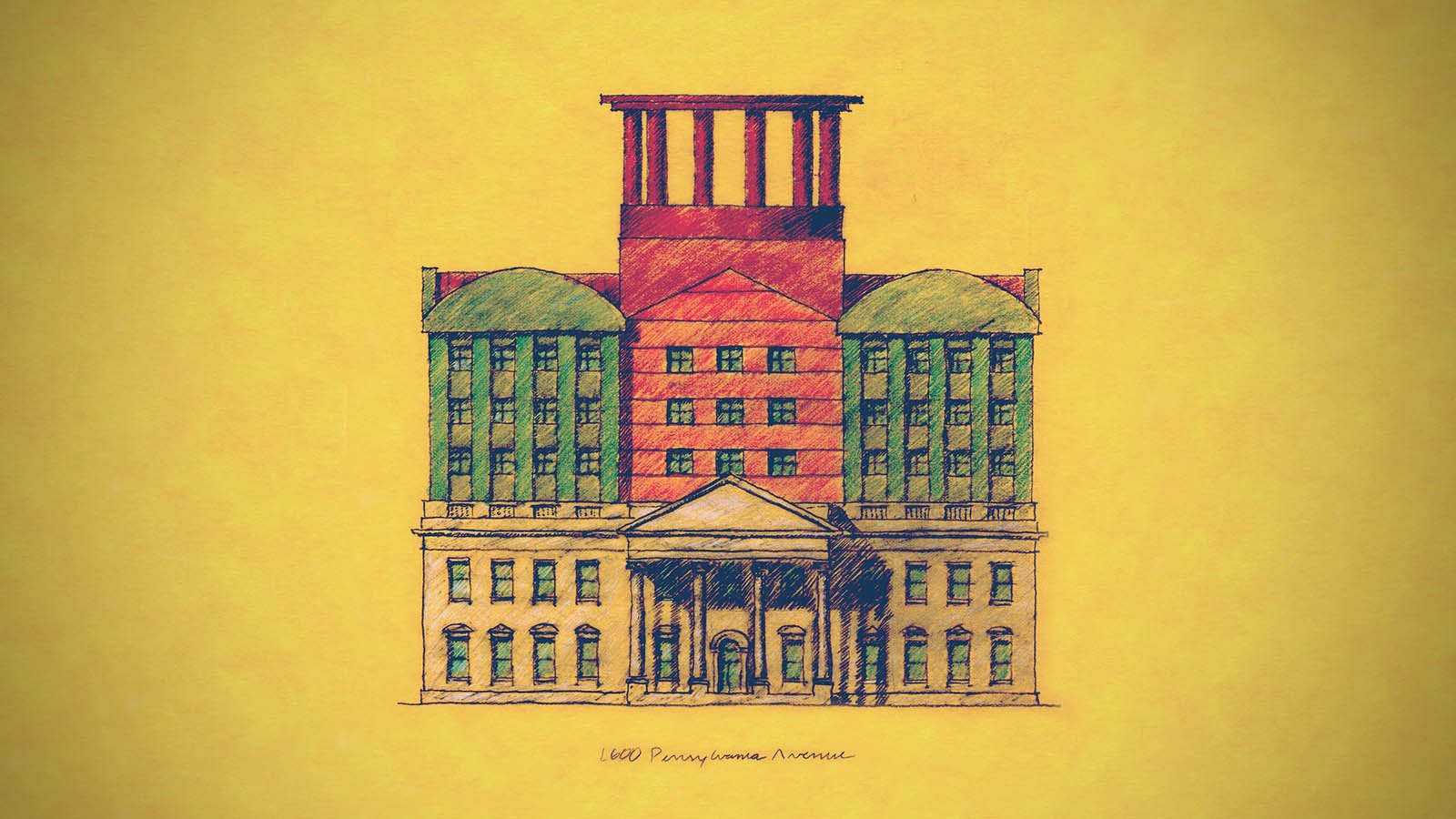
NOT a real Michael Graves proposal for the White House.
I was 24-years-old in early 2001. It had only been a few months since I started working at my first “real” architecture job, but I was already working 60-70 hour weeks (and most weekends). Although I would later look back favorably at my time at Perkins&Will, I was feeling the normal frustrations that accompany the transition from architecture school to architecture practice. And so when I learned about a contest to design a “new” White House, I carved out the time to enter it.
The speculative competition was sponsored by Dwell, an upstart magazine about modern residential design that had launched only a few months earlier. The intent was to explore ideas of modern living as well as the architectural expression of “abstract concepts such as freedom or democracy.” It was also hoped the contest would generate publicity for the new magazine.
At the time, I thought the proposal I submitted in response to the brief was quite clever. I called for leaving the White House itself untouched, but instead install a series of cameras that could could broadcast live video feeds of the activities of its inhabitants. I was clearly responding to the growing prevalence of reality television (at the time, Survivor was only in its second season), but what I couldn’t anticipate was that a future President might someday be a reality TV star himself.
From the vantage point of today, I feel the far more interesting part of my submission was the fictionalized history of the White House I presented. I referenced (and illustrated) a series of “unbuilt” proposals from iconic 20th century architects and provided tongue-in-cheek rationale for why these proposals were never realized. As potentially massive modifications to the White House are currently underway, it seemed worth revisiting my critiques of these fake plans as we consider these real ones.
Although I’d like to think my writing has improved in the past quarter-century, the text holds up reasonably well. The references to John Gray and Britney Spears may be dated, but I stand by the subtle shade I threw at Michael Graves. At any rate, the submission narrative is excerpted below. Only minimal edits have been made to the original text, including the correction of an embarrassing misspelling of “Mies van der Rohe" and the elimination of the equally-embarrassing double-space originally included after each period:
A HISTORY OF PROPOSED RENOVATIONS
With the growing complexity of the Executive Branch of the United States Government and the growing population it is charged to represent, the degree to which the White House has been able to meet the functional demands of the administration it houses has increasingly diminished over the last 200 years. As with any other house, the residents of this one have sought the advice of design professionals when it came time to make modifications.
Additions and modifications to the White House almost immediately after it was first occupied in 1800. The first call for serious alterations came in 1890 when Fred D. Owen was asked by then President Benjamin Harrison to propose additions to the White House. The plan called for two large wings to be added to either side of the existing White House. While the scheme was never implemented, it is interesting to note that had the proposal been executed, the subtle proportions the original building would have been lost and the image of the White House as a freestanding object would have been destroyed.
Some forty years later, Eleanor Roosevelt commissioned Frank Lloyd Wright to “suggest a few changes that might make [the White House] more contemporary and livable.” Wright responded with a proposal that included the demolition of the existing White House in addition to its surrounding city. While Mrs. Roosevelt was very much excited by the plan (and rumor has it, with Mr. Wright as well) she was unable to convince anyone else at the time that such a massive undertaking was wise at the time it was proposed. Still, the proposal survives as an interesting view into how America’s master architect viewed America’s democracy.
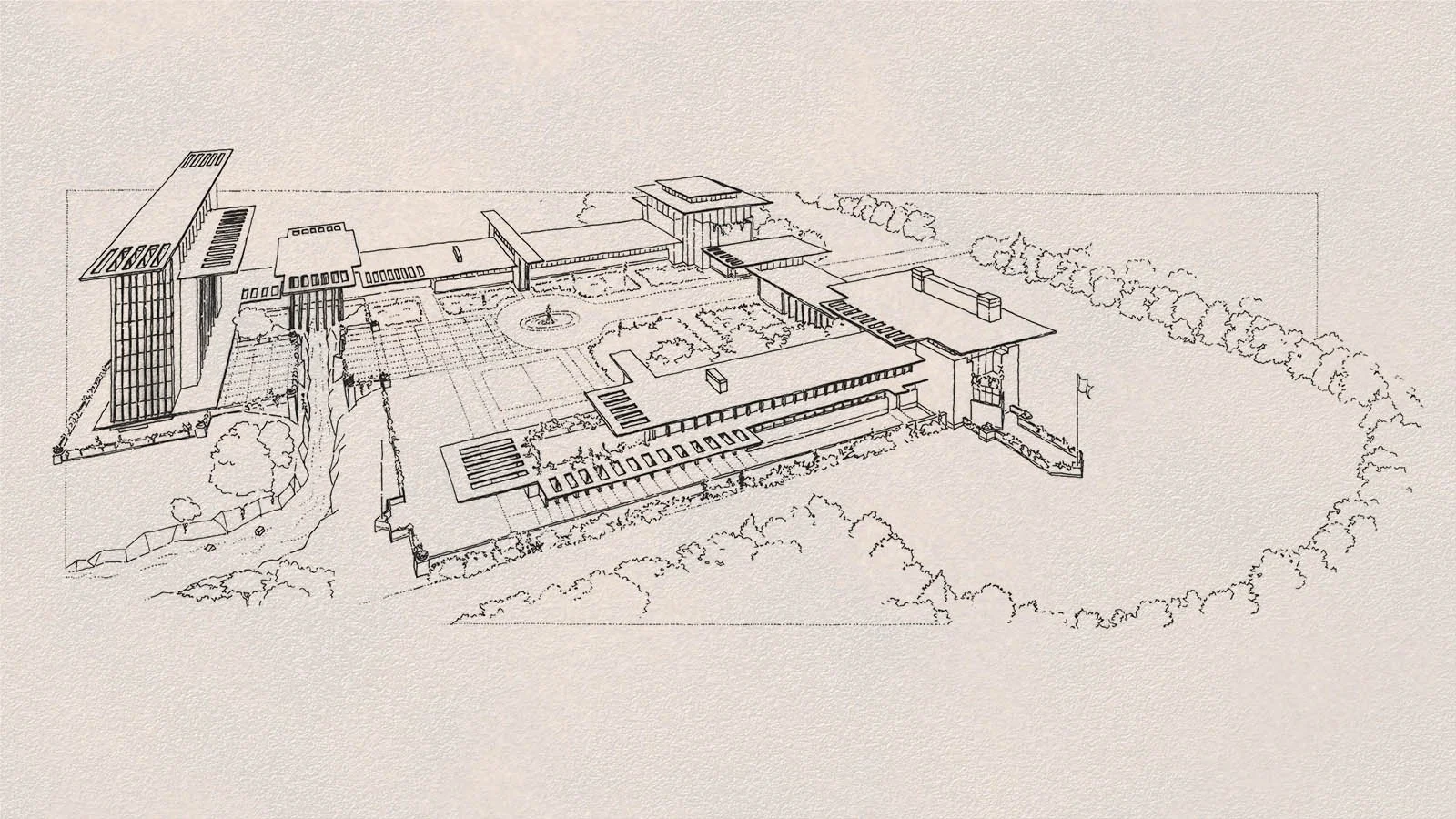
NOT a real Frank Lloyd Wright proposal for the White House.
in 1961, President Kennedy, called on Mies van der Rohe to submit a redesign of the White House that “Embodied the new spirit of American Democracy” that his administration sought to embody. This proposal consisted of an immaculately detailed glass pavilion that placed on public display the occupants of the building and their actions. This represented a shift in architectural thought from one that sought to preserve the privacy of those who lived and worked in the White House, to one that sought to exhibit them. As elegant as the design may have been, the Kennedy Administration was not impressed and decided to send astronauts to the moon rather than move forward with the design.
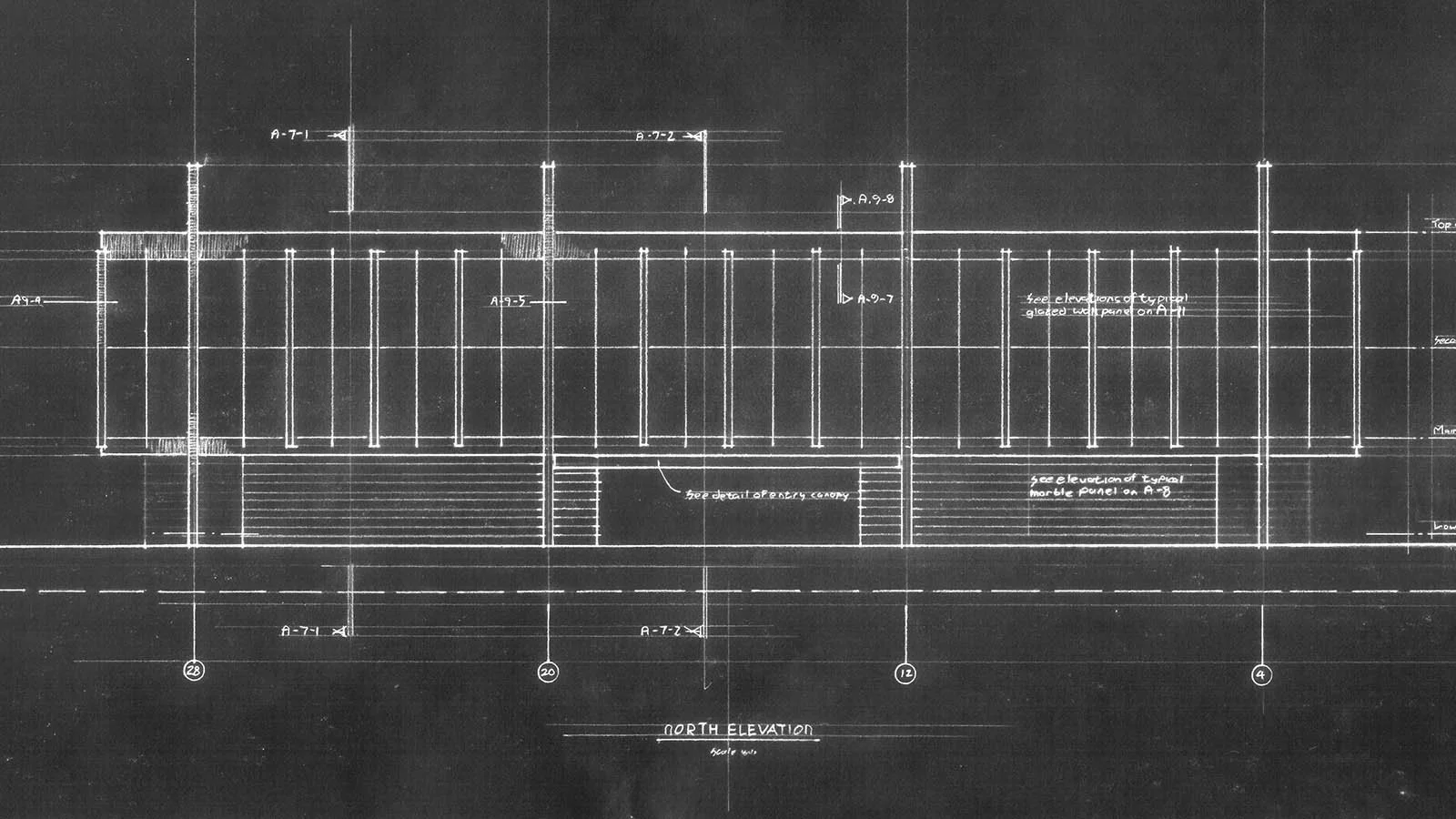
NOT a real Mies van der Rohe proposal for the White House.
In retrospect, a significant reason the Mies and Wright plans were not implemented was they both neglected to preserve the visual symbolism of the White House. While Mies had attempted to preserve some element of the original building in the proportional massing of his pavilion, that approach resulted in little more than what has to be considered one of Mies’s more clunky designs. As outdated and old-fashioned as the façade of the original White House might have been in the middle part of the twentieth century, it still provided the institution of the Presidency with an iconic symbol.
The final major proposal of the last century was submitted by Michael Graves in 1987. Graves was commissioned by President Reagan to propose an addition to the White House that provided additional office space. While the Graves plan did add square footage, no one could take the design seriously, and so it, too, was never executed. It was, however, the first scheme since Owen’s 1890 proposal that recognized the importance of preserving the original White House exterior.
A MODEST PROPOSAL
If anything should be learned from these un-built proposals, it is that the White House is more critical to the nation as a symbol than as a functional piece of architecture. As the office of the Presidency becomes more and more about symbolic representation, it only makes sense for the house the President lives in to reflect that same trend. As such, it is of critical important to preserve the symbolic meaning of the White House embedded in its façade. The institution and the building are too closely intertwined to permit the modification of the one without severely damaging the other.
With that said, the White House does make a rather ambivalent gesture toward the general citizenry. While tours are given and the exterior can be viewed by the public, the White House is, in essence, a private house for a public servant. The windows are small and the building itself is sited a good distance away from any point accessible to the average citizen. While security obviously plays an important role in driving many of these design decisions, it does make for a conflicting message: while the President is an elected official acting in a democracy, once elected, the public has little or no way to directly monitor his or her actions. The nation is forced to rely on secondary sources, such as the media, to deliver to them an edited paraphrasing of the events and actions that occur there. While their scrutiny of the President is intense, the information the press passes on to the public is always an interpretation of the events that actually occurred.
This is an inefficient and outdated means of communication.
TRENDS
The last decade of the Twentieth Century witnessed an unprecedented increase in the advance of communication technology via computer technology. The most significant effect on the general population has been in the way Americans accept and process information. The American People live in a world now where data—as opposed to wisdom or skill—is the key to success both in all aspects of life. If one is failing at investing, all he needs is more accurate and current stock information from CNBC in order to invest more successfully. If one is failing in a personal relationship, all he needs is more information from John Gray in order to fix that.
Much of this belief has been fostered by the nature of technological constructs such as the internet. The internet has allowed the nation (and for that matter, the world) to communicate any piece of information to anyone anywhere at anytime - weather that information be stock prices, our credit card number, or photographs of Britney Spears. It is not even the accuracy or validity of the information that matters so much - that is for the receiver of the information to decide. What is critical in this day and age is that pure, unmitigated information is instantly available.
There is also a growing trend in other facets of the media to document reality by documenting (or attempting to document) all of existence. MTV’s The Real World was an early attempt to do this, and though the footage was edited and pop music was dubbed to make reality a little more compelling, the concept of explaining events and relationships via pure observation without outside commentary was still at the core of the concept. The fact that this was also keenly entertaining is another fact worth mentioning.
Since the President of the United States is arguably the most important elected official, and since, while in office, he or she should be directly accountable to those he was elected to represent, it makes sense for the citizens of the United States to be able to monitor his or her conduct just as the nation was able to monitor the conduct of the couples of Temptation Island.
CONCEPT
There is no need to modify the physical structure of the house where the President lives. What is needed, is a modification to the ways in which that White House is made accessible to the public.
Just as Mies sought to employ architecture to put on local display the people and events occurring inside his 1961 White House proposal, the thought here is to employ contemporary communication technology to put those same people and events on display on a national scale. What is proposed, then, is that a network of miniature cameras be installed throughout the White House to record and broadcast the actions of the President - both the extraordinary and the mundane - to the nation he or she represents. The nation, then, would be given a variety of means through which this information could be viewed and interpreted.
The actual cost of implementation of this plan would be minimal. Current technology allows for small cameras to record and transmit high quality visual images. A network of these miniature cameras could easily be integrated into the preexisting architecture of the White House. The CIA and FBI would be excellent consultants for the placement of this technology, since these two organizations together have extensive experience in this form of cinematography. A media control center would need to be installed so that the streaming video could be broadcast and catalogued, and the camera equipment could be maintained. Most likely this addition would be placed somewhere within the vast underground complex that exists beneath the White House, perhaps next to the harem.
MEDIA
The medium through which this video information would be made available to the public would be varied. Naturally a web site could easily provide 24-hour web-broadcasts of the footage, and a C-SPAN-like network could be created to do a similar job for cable TV. Important events, such as summits, impeachments and wars could be promoted as “pay-per-view” events to earn extra revenue for the government.
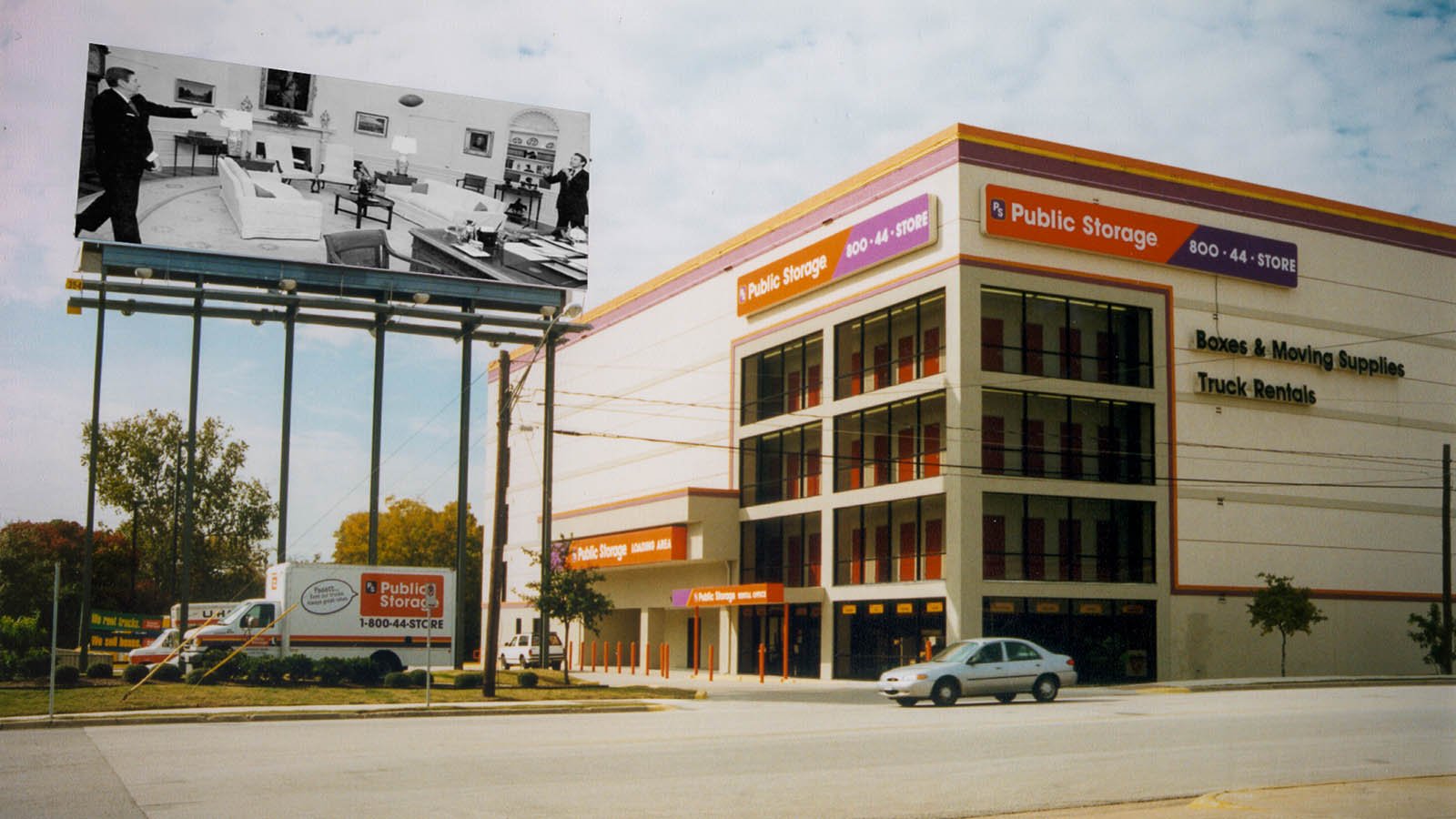
Other, more public means of broadcast should also be examined. Billboards could be converted into projection screens allowing for Presidential review to occur on our nation’s highways.
Small, self-contained viewing screens would also be produced and installed in locations throughout the country. These units would consist of a protected plasma-display screen in addition to photo-voltaic cells, batteries, and a receiver dish. The unit, then, would function as an independent unit, and thus be able to be located anywhere, and moved with relative ease. They could be placed in public locations (libraries, national parks, street-corners, etc.) such that the public who might not have direct access to the internet or television would still, on occasion, be able to observe the doings of those in the White House.
While this final element might be reminiscent of the omnipresent “Big Brother” in George Orwell’s 1984, it should be remembered that the displays described in that book were used by the government to keep an eye on the public. In this proposal, the displays are used by the public to keep an eye on the government. The difference is perhaps slight, but the implication is profound.
CONCLUSION
In closing, it should be noted that with a few minor Constitutional amendments, this technology could become a central part of a new way of electing Presidents. It would not be difficult to imagine a situation where each political party would submit five candidates who would be organized into two “tribes” living within the White House. Over the course of several weeks, the candidates would each be subjected to some type of “physical or mental challenge” that would prove or disprove their leadership ability. At the end of each challenge, which of course would be broadcast over the media network described above, the public would be able to vote one candidate out of the White House. This process would continue until only one candidate remained, with that individual becoming the new President of the United States.